A fine line flower tattoo ages well when it has fewer petals than you expect, real space between every line and a stem that follows the shape of your body. I draw each flower a little simplified and a little larger than a botanical print, so the petals stay separate as the skin settles. Lily of the valley, poppies and lavender all suit this approach.
Most fine line flower tattoo galleries show beautiful fresh photos and stop there. What they rarely explain is why some flowers still read clearly years later and others turn into a soft smudge. That is the part I think about most when I draw one.
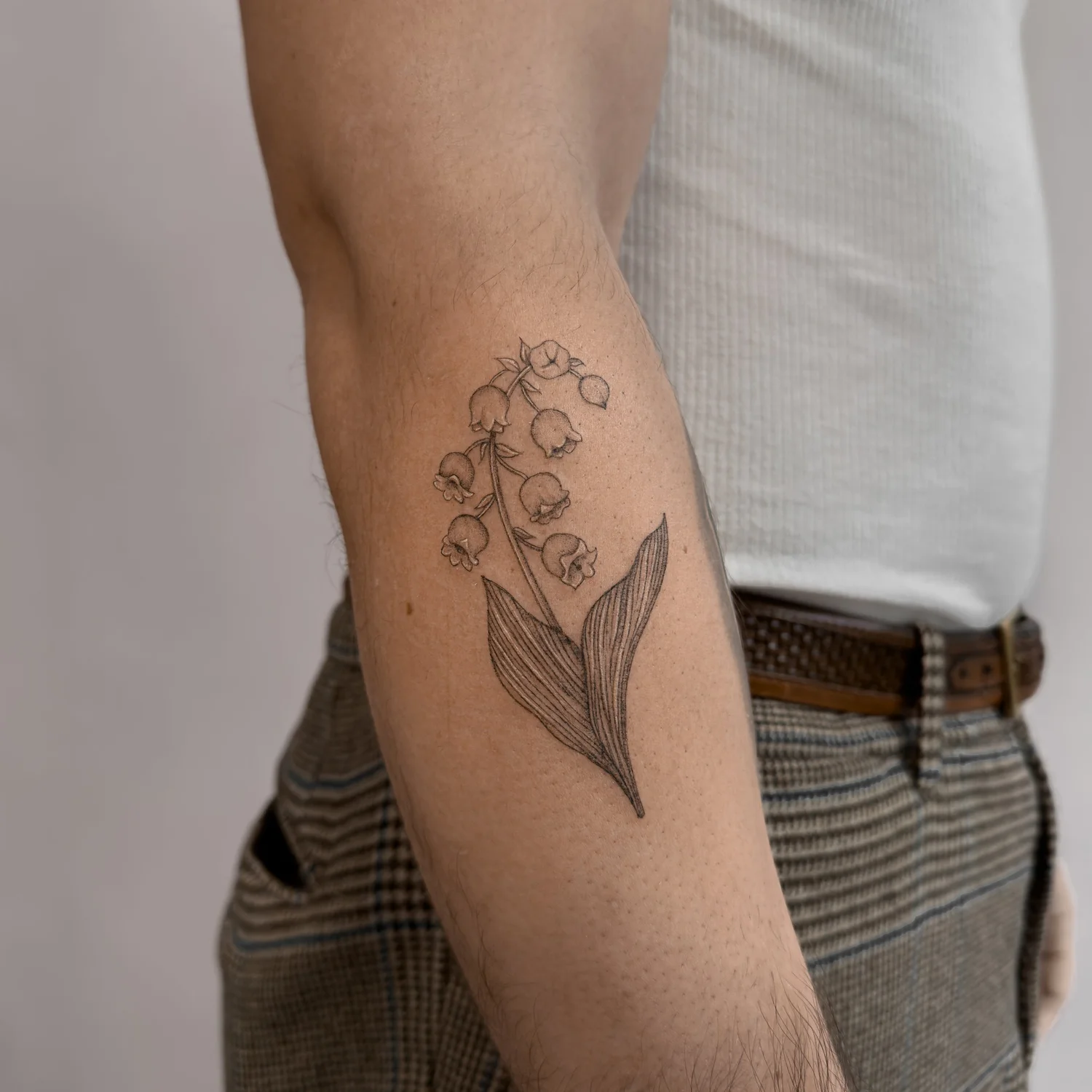
What makes a fine line flower tattoo age well?
Every tattoo softens over time, and fine lines show it first because each line holds so little ink. Flowers are full of the details that suffer most: petals that overlap, tiny centers, veins drawn close together and small closed shapes between leaves.
So I design for the healed tattoo, not the photo on the day. In practice that means:
- Fewer petals. A real rose might have dozens. A fine line rose needs only enough to read as a rose.
- Gaps where petals overlap. A small break in the line keeps two petals from merging into one shape.
- Centers sized up. Stamens and seeds drawn as a few clear dots last longer than a dense cluster.
- Leaves with open veins, or no veins at all, when the leaf is small.
Which flowers work best as fine line tattoos?
Almost any flower can work if it is drawn for skin. Some shapes make it easier:
- Lily of the valley. The small bells hang from a single stem, which gives the design natural movement and leaves space between each bloom.
- Poppies. A few big, soft petals and a long stem. Very readable, even at a modest size.
- Lavender. Many tiny buds, so I group them into a clear silhouette rather than drawing every bud separately.
- Pansies. A single bloom on a stem works beautifully, as long as the face of the flower has room.
- Branches and greenery. Olive branches and leafy stems wrap the arm well and pair easily with a bloom.
Flowers with many small layered petals, like peonies or tight roses, can still work. They just need more size so the layers stay open.
Should a fine line flower tattoo be black or color?
Both can be lovely, and the choice changes how I draw it.
In black and grey, the line does most of the work. I keep shading light and use it to give petals a little shape, building enough contrast that it does not disappear once healed. I wrote about why light greys heal lighter in my post on single needle shading.
In color, the petals carry the design. A single color poppy reads instantly because the red does the talking, so the line around it can stay quiet.
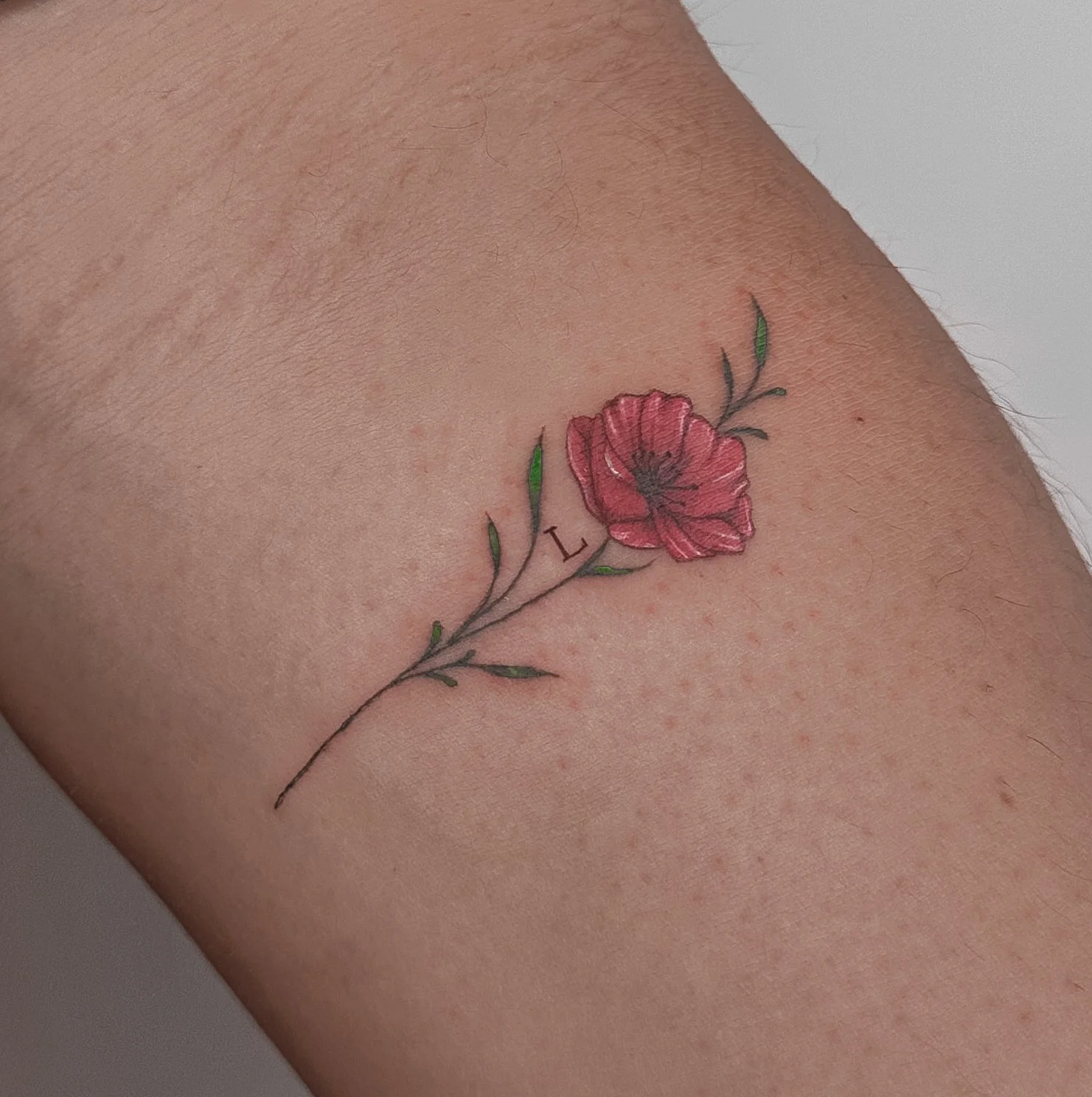
Color work needs the same care with sun as black work. Living in Los Angeles, keeping a healed flower out of strong sun is the habit that does the most for it.
Where should a fine line flower tattoo go?
Flowers are one of the easiest subjects to place, because stems can bend to follow the body.
- The forearm is my favorite. It is fairly flat, easy to care for and a long stem can run along it.
- The upper arm suits a single bloom, like the poppy.
- The ribs and side body suit long, loose sprays that move with you.
- Wrapping branches suit anyone who wants something that grows around the arm.
I am more careful with fingers and the inner wrist, because friction and washing soften small petals fastest there. The studio's guide to the best placement for a fine line tattoo goes deeper on this.
How do I design your fine line flower tattoo?
Every design I make is drawn new for the person getting it. Send me the flower you have in mind, a photo of the real plant if you have one, and any tattoos you like the feel of. Real plant photos help me most, because I can see how the petals actually sit before I simplify them.
From there I decide how many petals to keep, how the stem should move on your placement and whether black, grey or color suits the idea best. My custom tattoo design process walks through each step.
How do you care for a fine line flower tattoo while it heals?
The full two-week routine is in the Kastana aftercare guide.
If a petal looks patchy once healed, I include one free touch-up within six months.
FAQ
How small can a fine line flower tattoo be?
Small enough to feel delicate, but big enough that petals and leaves stay separate. Simple flowers can go smaller than layered ones. I will suggest a size once I see your idea and placement.
Can I combine several flowers in one tattoo?
Yes. A small bouquet or a single stem with a few different blooms works well in fine line. It needs a little more room so each flower keeps its own shape.
Do I need a finished design before I book?
No. Send me the flower and a few references and I will draw it for you. You can see more of my work at whoisagne.com.
How much does a fine line flower tattoo cost?
My minimum is $300. Larger or more detailed pieces are quoted individually after you send me your idea.
If there is a flower you want to carry with you, book with me at Kastana.